

Often it takes just a few notes to change how we feel.
A gentle piano with long sustained notes melody can make us nostalgic and emotional.
A fast dance track with punchy drums can instantly boost our energy.
A dramatic movie soundtrack can create tension long before anything happens on screen.
Music has an extraordinary ability to influence our emotions, often within seconds.
Why do some songs sound joyful and uplifting while others feel emotional, melancholic, or even unsettling? Is there something built into the music itself that creates these feelings, or are our reactions shaped by personal memories and cultural experiences?
The answer is a combination of both. Music communicates emotion through several elements, including scales, tempo, harmony, timbre, melody and rhythm. At the same time, our brains interpret these elements through the lens of our own experiences.
In this article, we'll explore the key musical ingredients that shape emotion and provide interactive listening examples so you can hear these effects for yourself.
At its essence, music is an artistic interpretation of the sounds we encounter in our environment
Music Mimics Nature to Evoke Emotions
Music “mimics” sounds we know from our natural environments since thousands of years
- The sound of the human voice and how humans choose to speak when they are either happy or sad
- Wind & weather events
- Rivers
- Caves
- Animals
- Forests
- Fire
Composers use these associations in their music to create various emotions. Let’s talk about the elements composers use to evoke emotions, derived from these sound natural sources.

#1 Pitch: Major vs. Minor Scales
If you've ever taken a music lesson, you've probably heard that major sounds happy while minor sounds sad.
We will see that is is only half the truth but it's one of the most foundational concepts in Western music.
Major and minor scales use different arrangements of notes. The difference may seem small on paper, but it creates a noticeably different emotional character.
Major keys often feel bright, open, and optimistic.
Minor keys tend to feel more introspective, emotional, or dramatic.
Why does major sound happy?
When someone is happy, the voice tend to be more energetic, varied in pitch, and acoustically similar to the intervals found in major scales. The major third, introduced early in the scale, contributes to a brighter and more stable sound that many listeners perceive as confident, uplifting, or positive. With more energy, the human voice naturally varies more in pitch and speed and due to the increased air flow, the notes sound louder aswell.
Major scales say: “I am energetic and spontaneous. I want to go high in pitch!”
Why does minor sound sad?
Sad speech, by contrast, is often quieter, slower, and less energetic. To produce higher notes and more pitch variation with the human voice, more energy is needed. That means, someone being sad naturally tends to keep their pitch lower because physical energy is lacking here.
The minor scale introduces a smaller interval between the second and third scale degree, creating a more subdued character. This gives the scale a more chromatic and emotionally tense quality than the major scale, which many listeners associate with sadness, melancholy, or introspection.
Minor scales say: “I am insecure with low energy and therefore i don’t have the power to produce energetic notes high in pitch”
The fascinating part is that those associations are not the same across the globe. For example, the Khowar- and Kalash-speaking communities of northwestern Pakistan tend to perceive major modes as sad and minor modes as happy—the reverse of what is common in many Western cultures. This difference is likely influenced by the characteristics and musical traditions of their native languages.
The distinction between happy and sad scales and chords arise from their inherent duality. Without happiness, sadness would be difficult to define, just as happiness would lose its meaning without sadness. Our understanding of emotions is shaped, at least in part, by the contrasts between them.
That means a minor chord on its own is not “sad” per se. It becomes sad when we have a major chord to compare it with.
Relevant for us to determine if major is happy and minor is sad, is the first noticeable difference in the two scales when played in a logical order (from low to high).
Listening Example
Major Scale (Happy and energetic)
Audio Example 1: Major Scale (C - D - E - F- G - A - B - C)
Minor Scale (Sad and introspective)
Audio Example 2: Minor Scale (C - D - Eb - F- G - Ab - Bb - C)
Notice how the first two notes are exactly the same, but once we have reached the third note, we can instantly distinguish the energy and attitude between these two. The major scale features a whole step (from D to E) while the minor scale is characterized by its half step at this point (D to Eb).
No matter how the scale continues, our brain already categorized it at this point.
After that, the minor scale introduces another half tone step between the G and the Ab (5th and 6th note) while on the major scale went up a whole step (G→A). This is the next point at which our brain tells us that in the minor scale, there is energy lacking (half step) to go from the G to the next note associating it with a sad mood. It is “sluggish” and “wants” to stay low in pitch.
The last difference is the step from B to C and here it is all the way around. The whole step is in the minor scale, while the major scale has a half-step here. But at this point, our brain already clearly identified and categorized it so that this change does not have the relevance anymore to turn our association around.
#2 Tempo
Tempo refers to the speed of music and is usually measured in BPM, or beats per minute. Faster tempos generally create feelings of excitement, joy, urgency, and movement. Slower tempos often encourage reflection, intimacy, and emotional depth.
When people speak happily or with positive excitement, they tend to speak faster as well. Since music is built around logical rhythmic patterns, composers can take advantage of the time it takes to move from one note or drum hit to the next.
Shorter intervals between sounds often create a more energetic and uplifting feeling, while longer intervals can make the music feel more subdued or contemplative.
Tempo does not change the emotion fundamentally, but has more effect on the energy of the track.
Music in Major music played fast can sound Funny or Exciting.


Music in minor played fast can sound urgent or nervous.

Even if the pitch remains identical, the energy would be different if played slower or faster.
This connection may exist because tempo mirrors physical experiences. Fast (heart-)beats and speech are associated with excitement and action, while slower rhythms are linked to calmness and contemplation.
Many genres use tempo strategically. Dance music often sits at higher BPM ranges to encourage movement, while emotional ballads typically use slower tempos to create space for melodic expression.
Listening Example
Compare the same chord progression played at two different speeds:
Example 3: Major Chord progression played slow then fast
Slow: relaxed and carefree
Fast: upbeat and energetic
Example 4: Minor Chord progression played slow then fast
Slow: A lot of space between the chords makes it dramatic and tragic.
Fast: more alert and almost hectic
Notice how the atmosphere changes even though the underlying harmony (and rhythm) remains the same.
#3 Timbre
The timbre of a sound plays a huge role in telling our brain how to categorize its soundsource and it describes how bright or mellow it is.
As I outlined earlier, we subconsciously connect the sounds of instruments to the sounds we know from nature. Depending on the overtone spectrum of an instrument and how loud it is played, it can remind our brain of things found in nature that may either benefit us or pose a threat.
When you play a note on any instrument, you will not hear just one frequency.
A note played on an instrument consists of a fundamental frequency (the “root”) which is often the lowest peak of the signal and a lot of higher frequencies (its “harmonics”) which all add up to form a distinct “pattern”.
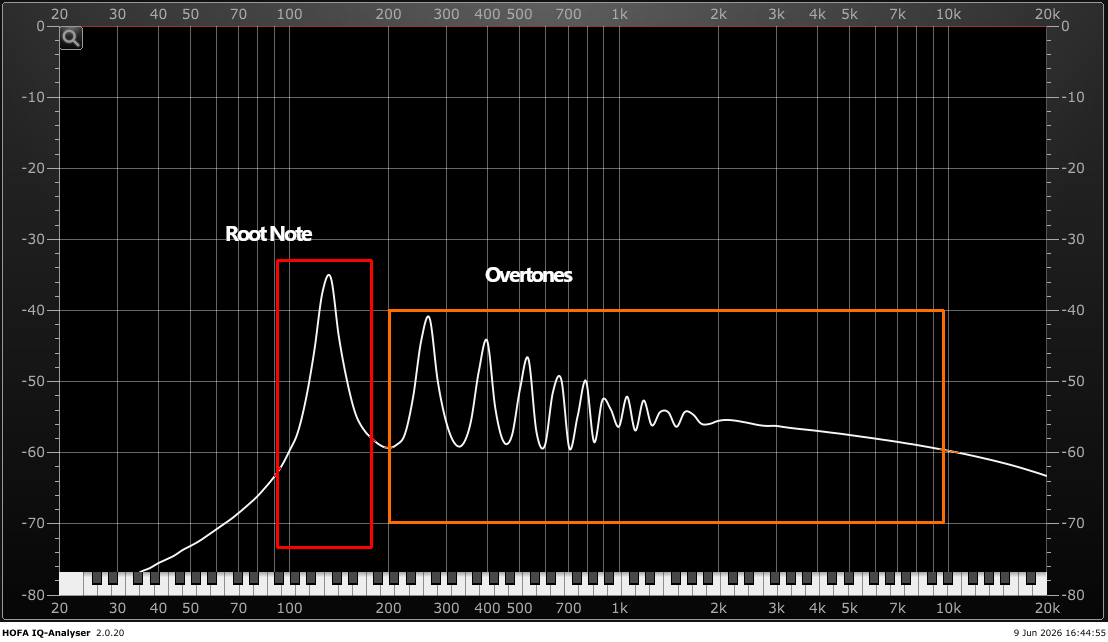
This image shows a frequency analyzer.
X-axis: low frequencies (left) all the way to high frerquencies (right).
Y-axis: how loud it is, from quiet (bottom) to loud (top)
A note played on an instrument is a mix of frequencies.
Party because of how these overtones are shaped, we can tell “this is a guitar!” or “this is a piano!”. If we would only hear the root frequency, we would never know which instrument is playing that note.
The orange marked section is called the “overtone spectrum” of an instrument and it defines its character.
Let’s make this a bit easier to understand.
All of these instruments are playing the exact same note. Notice how different the overtones are distributed across the spectrum:
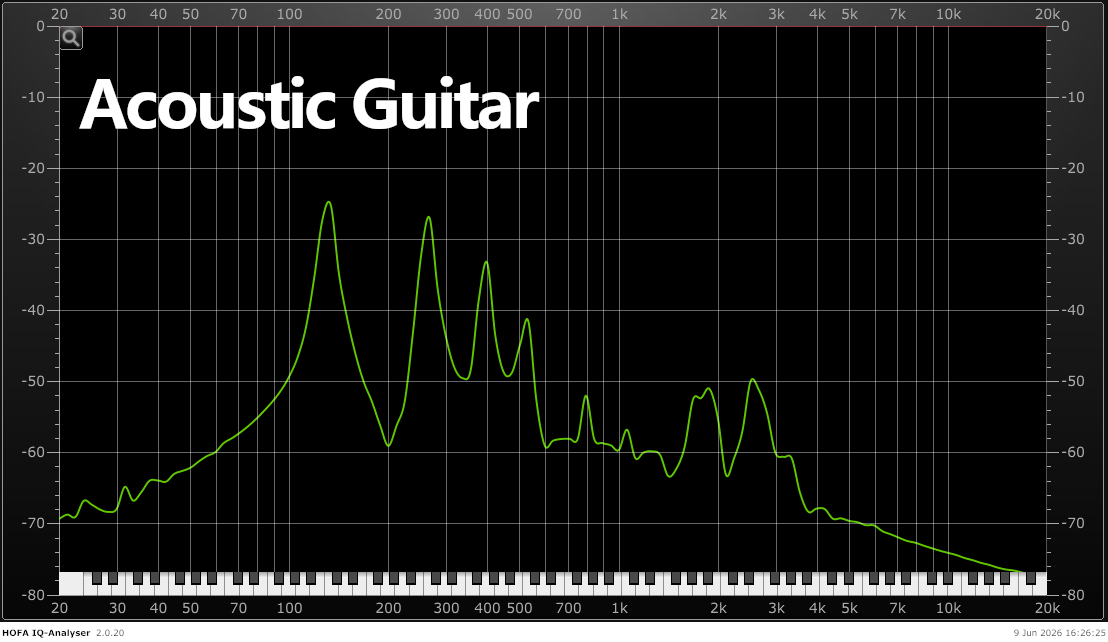
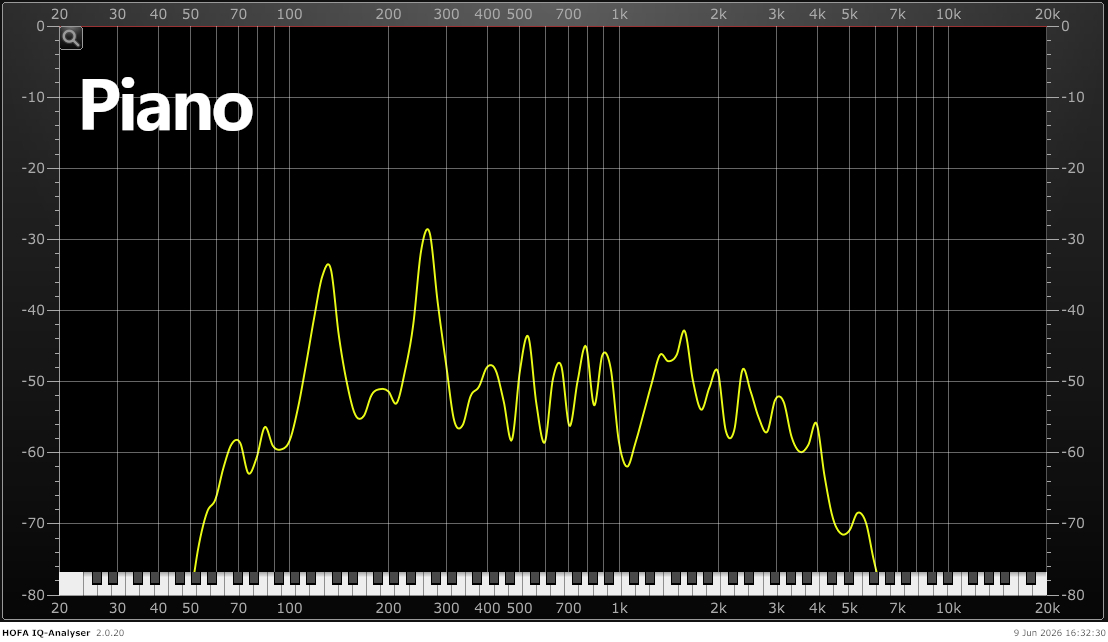
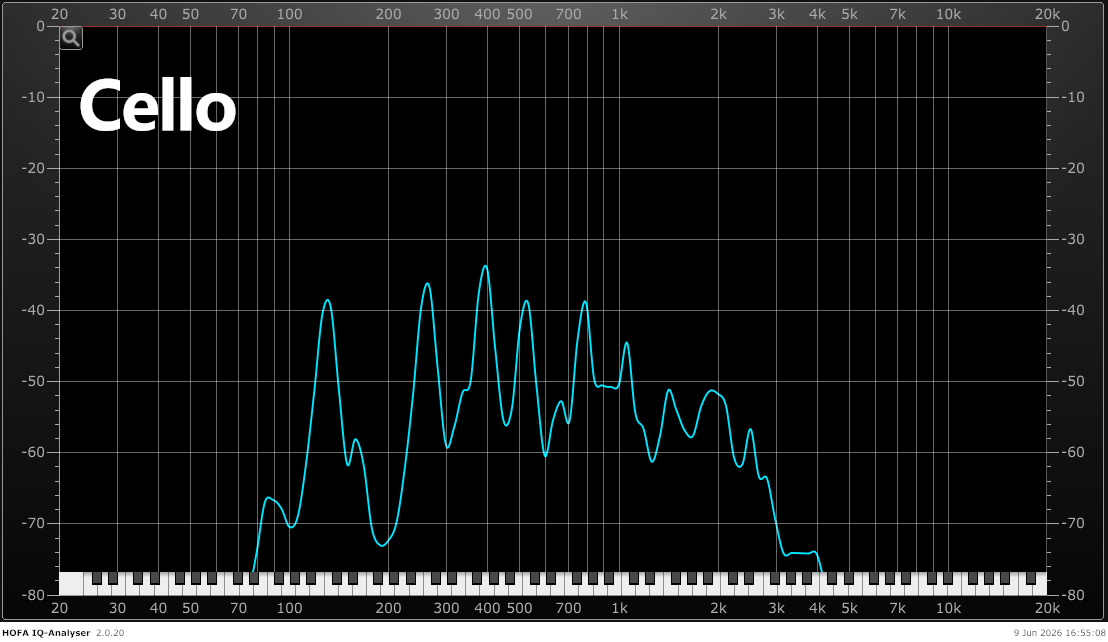
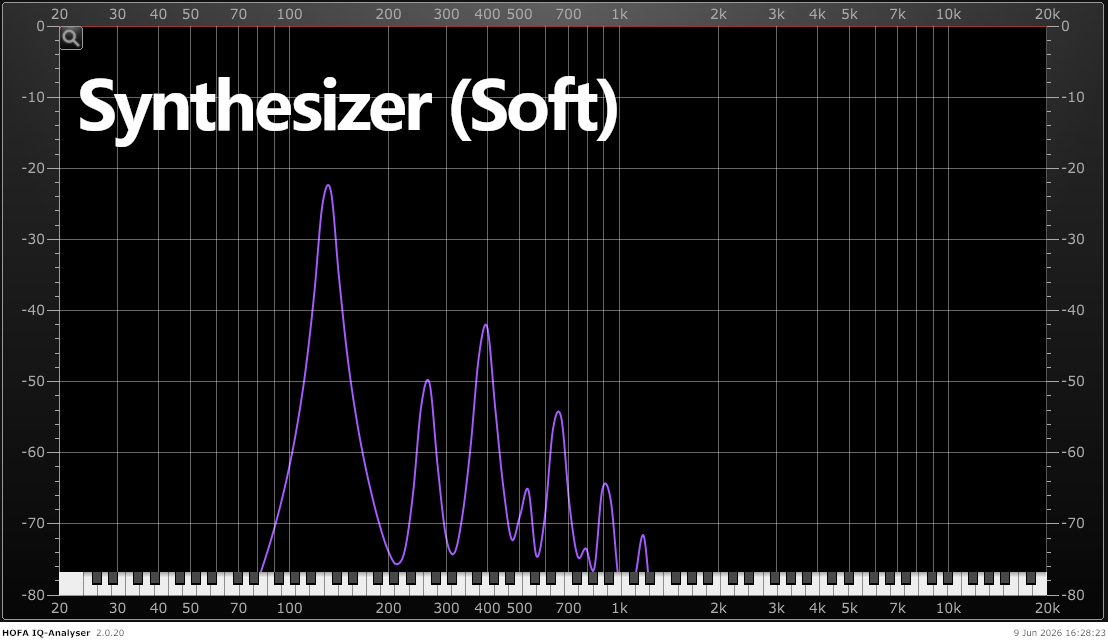
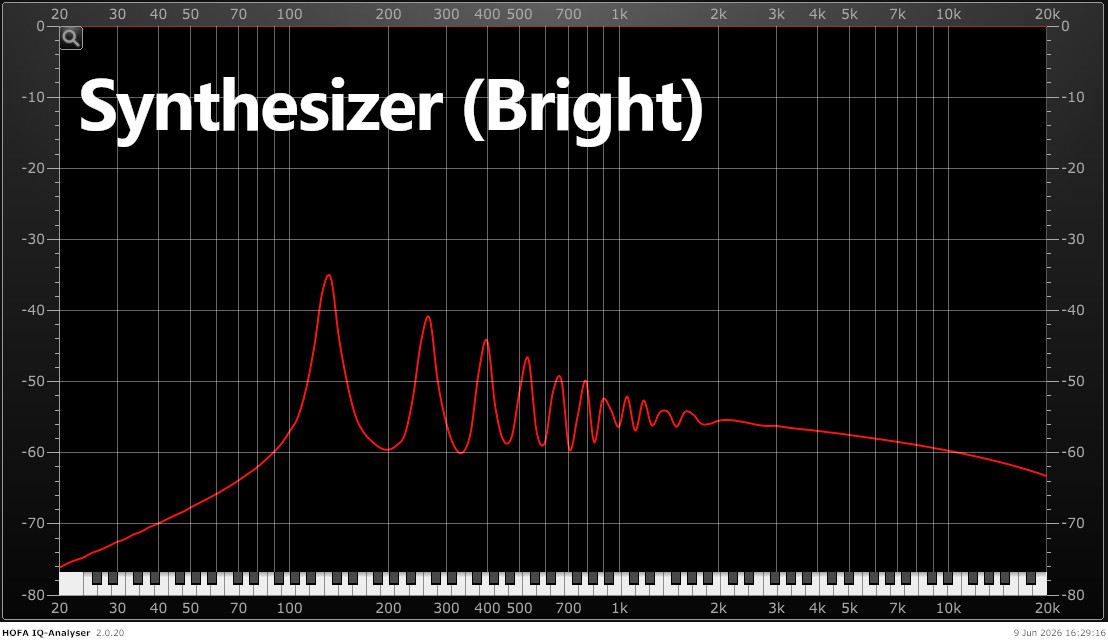
Notice how soft sounds have less overtones?
A long time ago when we were cavemen, nearby thunders, heavy rain, growl’s of dangerous animals and screams all produced sounds which are bright and inharmonic. As a result, they can trigger responses that are less associated with relaxation and happiness and more with action, alertness, or threat.
Soft, mellow and harmonic tones with less high frequencies, like those of the Cello, remind us of softly spoken words, a lush breeze, distant sounds or singing. Our brain interprets these sounds as signals that “Everything is okay. I am safe. Time to rest.”

One of the most important factors in determining whether a sound feels relaxing or energetic is how it unfolds over time.
A gentle swell, like this synthesizer pad, works particularly well in relaxing music because it draws our attention gradually. Since the sound emerges slowly rather than appearing suddenly, the brain perceives it as less threatening and has time to adjust, contributing to a sense of calm.
In contrast, sudden bursts of sound capture our attention immediately. This naturally increases our alertness and sense of awareness, making such sounds ideal for energetic musical moments. The brain thinks “I have to be quick and alert to identify and categorize the soundsource”.
Composers use these principles when choosing a palette of instruments and performance techniques, ensuring that every musical element supports the same goal: evoking the intended emotion and energy.
Music made to relax features a lot of subdued and quieter sounds with less overtones. The volume is more stable and it is not introducing too many different sections so our ears do not get overwhelmed:

Music made to stimulate our senses is bright, punchy and loud, and the instruments have more overtones, like in this example:

#4 Chords and Harmony: Tension, Release, and Emotional Pull
Emotion also comes from how tones interact with one another.
When at least two notes are played simultaneously, it is called a “harmony”. Some combinations feel stable and comfortable, while others create tension that seems to demand resolution.
Musicians often describe this relationship as consonance and dissonance.
Dissonant harmonies create friction and suspense.
Consonant harmonies release that friction and feel smooth and resolved.
The emotional journey often comes from moving between these states
Tension (”something is off”)
…and release. (”now it is where it needs to be!”)
Here is a chord progression which is satisfying to listen to, because it creates tension and then releases it in different ways each time:
If there were no tension and release, music could sound boring. Listening to the progression of chords (tension and release) releases dopamine in the brain because our brain naturally wants to bring things “back into order”. This is what makes music exciting to listen to.
A progression that resolves quickly is a good choice for creating happy or relaxing music because it does not “cause any trouble.” It stays harmonious. It makes us feel good because, throughout the listening experience, we do not encounter things that “need to be fixed.” This gives us a sense that everything is under control, so we do not need to stay alert.
A progression, on the other hand, that deliberately avoids resolution puts us in a state of higher alertness because it leaves us hanging. This makes it a great choice to express more complex emotions, such as anger, fear, insecurity, or drama.
Example of an chord progression which does not resolve to its root chord.
#5 Rhythm and Groove
Before we analyze music emotionally, our bodies often react to it first.
We tap our feet, nod our heads, or start moving instinctively.
Rhythm is one of the most powerful drivers of emotional response because it connects directly to physical movement.
Listening Example
Compare these two drum beats played at exactly the same tempo:
Example 1: A straight drum groove
A strong, predictable pulse creates stability and confidence. Perfect for catchy music genres such as pop and electronic dance music where music needs to be danceable. They provide a very solid foundation and give “power” to other melodic instruments.
Example 2: A syncopated groove with unexpected accents
More complex rhythms like this one can create excitement, tension, and surprise. They are especially common in styles where rhythm plays a more prominent role than catchy melodies or harmonic progressions. Because of their complexity and activity, these rhythms occupy more space in a mix and often become a defining element of the music.
An important concept to understand here is syncopation.
Syncopated rhythms place emphasis on unexpected beats, creating a sense of forward motion and energy. Many expressive, groove-driven styles such as funk and jazz rely heavily on syncopation to create their distinctive feel.
#6 Context, Memory, and Culture
Although musical structures matter, emotion doesn't exist solely within the music itself.
Our personal experiences play an enormous role.
A song connected to a childhood memory may feel deeply emotional to one person while sounding completely ordinary to someone else.
Film soundtracks also teach us emotional associations. We learn to connect certain sounds with romance, suspense, victory, or sadness because we've repeatedly encountered them in specific contexts.
Culture matters as well.
Different musical traditions around the world use scales, rhythms, and tonal systems that may communicate emotion differently.
What sounds melancholic in one culture may not carry exactly the same meaning in another.
This helps explain why music is both universal and deeply personal.

Conclusion
What we have covered here are the most important elements of why music triggers emotions, but by far they are not all.
Music shapes emotion through a remarkable combination of elements.
The most important ones are:
- Scales (Major and Minor) - influence whether music feels bright or dark.
- Tempo - affects energy and intensity.
- Harmony - creates tension and release.
- Timbre - changes the character of every note.
- Rhythm - connects music directly to physical movement.
- Personal memories - add layers of meaning that no composer can fully control.
Together, these ingredients transform organized sound into one of humanity's most powerful emotional experiences.
Yet one question remains:
Can music ever be objectively happy or sad, or are those emotions always created by the listener?
Explore the examples throughout this article and decide for yourself. You may discover that the emotional power of music lies somewhere between the notes and the person hearing them.