

TL;DR
- Horror sound design combines music, sound effects, and ambience to create tension, fear, and a sense of uncertainty.
- Dissonance, drones, low frequencies, and unexpected sounds can make a scene feel unsettling especially when the threat is not visible.
- Silence and dynamic contrast are powerful tools because they influence what the audience expects to hear next.
- Effective horror soundscapes often suggest danger outside the frame instead of revealing everything directly.
- The best results usually come from carefully layering ambience, sound effects, and music rather than constantly filling a scene with dramatic audio.
Sound design plays an essential role in how we experience horror. A dark hallway may already look unsettling, but the sound design can completely change how threatening the same images feel.
Horror filmmakers work with music, sound effects, ambience, silence, and changes in dynamics to influence what the audience expects and where their attention is directed.
In this article we’ll explain not only how horror sound design works in movies, but also how you can create your own scary soundscapes using HookSounds.
What Is Sound Design in Films?
When speaking about films, sound design is the creative process of selecting or creating sounds and noises, recording, manipulating, and arranging audio to create a distinct atmosphere.
Depending on the desired emotion, horror sound design may consist of dozens of individual layers ranging all the way to complete silence. Room tone, footsteps, wind, breathing, electrical hums, distant impacts, drones, risers, distorted textures, and music can all contribute to the atmosphere of a scene.
Foley artists work with everything from subtle environmental sounds to highly processed effects and dramatic musical elements:
Great horror sound design doesn't always have to sound obviously frightening. In many cases, its purpose is simply to create the impression that something in the environment feels unusual or unsafe.
It can be a subtle art.
How Horror Sound Design Creates Fear
Horror sound design works by creating feelings of uncertainty and vulnerability in the face of a perceived threat. Sound designers strategically use different sonic elements and characteristics to shape the exact emotional response a scene requires.
Like a painter using different brushes and colors to influence the mood of an image, horror sound designers use the following sound characteristics:
Dissonance
Dissonant intervals, unstable harmonies, and harsh textures can make a scene feel unresolved or uncomfortable.
Low Drones and Rumbles
Low drones and rumbles can suggest the presence of a powerful threat, making the audience feel vulnerable and exposed.
Silence
Silence, a gentle noise, or room tone is often used as a bridge between sonic events. It increases anticipation and makes the audience more sensitive to every detail.
Listen carefully, it’s subtle!
Close Sounds
Sudden impacts, approaching footsteps or musical hits are most effective when they follow quieter moments. The contrast between low and high intensity is what makes these sounds feel surprising.
The most intense horror scenes often rely primarily on atmospheres and sound effects, as their seemingly random rhythmic and sonic qualities feel closer to the unpredictable sounds of our environment.
Horror Music
Because music is built from a relatively ordered sequence of sounds, it can reduce uncertainty. Horror music is used to shift attention away from intensely perceived sound details toward the scene’s overall mood, as it clearly tells us how to feel.


Make the Audience Hear What They Can't See
Giving sonic hints that something unsettling but hidden is near the protagonist is one of the core ways movies create fear.
Horror sound design often suggests threats outside the camera frame through footsteps upstairs, scratching behind a wall, or movement in another room. Because the audience hears the threat without seeing its source, uncertainty begins to build—one of the key conditions that gives rise to fear.
By definition, fear is an adaptive emotional response to a perceived threat that prepares us to detect danger and react to it. It can influence our attention, thoughts, physiological responses, and behavior.
How to Create a Horror Soundscape
Let’s take a hands-on approach to horror sound design.
First, you have to clearly determine what the audience or your main character should feel during a scene. Then make use of the core principles described above to achieve that.
A useful approach is to divide the soundscape into three main layers:
- Ambience creates the acoustic environment in which everything else takes place. A nighttime forest might contain wind, insects, distant animals, moving branches, and leaves, while an abandoned building might include room tone, pipes, structural creaks, electrical noises, and distant traffic. These sounds may seem insignificant, but they help establish a believable space in which the frightening elements can exist.
- Sound effects represent more specific events or actions. Footsteps, screams, doors, impacts, breaking glass, breathing, scratching, and objects moving around a room are typical examples. Some directly correspond to something visible on screen, while others may be introduced to support the atmosphere or suggest events happening outside the frame.
- Music primarily communicates emotion and establishes the overall tone of a scene. Horror scores may use orchestral strings, synthesizers, percussion, piano, drones, distorted textures, or combinations of traditional and experimental instruments. Music can warn the audience about approaching danger or create tension even when nothing threatening is visible yet.
Practical example: Building a horror soundscape with 3 different layers:
1. Ambience
Begin by establishing the acoustic environment.
The basement might contain a low room tone, occasional water drops, ventilation noise, distant pipes, an electrical hum, or wind entering through a damaged window.
These sounds should generally remain subtle because their primary purpose is establishing the location.
You can also change the ambience as the tension increases. An electrical hum might gradually become louder, or an established dripping sound may unexpectedly stop. Altering something the audience has already become accustomed to can indicate that the environment has changed without introducing an obvious horror effect.
Scene: The camera slowly moves along the floor in a basement of an abandoned, industrial building.
We are using 3 layers of horror sound effects from HookSounds to build this dark and eerie industrial hall soundscape:
2. Sound effects
The next layer contains individual sounds connected to the character and the objects they interact with.
- Footsteps
- Clothing movement
- Camera handling noises
- Breathing
- Doors
- Wooden structures
- Loose pipes
- Objects being moved
They can make the scene feel much more detailed and realistic.
Scene: A man hears scary noises in the middle of the night and decides to check on it… until…
The complete sound design of this scene was achieved using only HookSounds’ sound effect library.
When we talk about sound effects, we are often also talking about sound design.
This is where Foley becomes useful. Foley artists recreate everyday sounds during post-production, allowing filmmakers to precisely control how footsteps, clothing, objects, and other movements sound. In horror sound design, these recordings can be exaggerated slightly to make actions feel heavier or more uncomfortable.
As illustrated in the scene above, the trick to how movies create fear is to add sounds that do not have an immediately visible source. A metallic impact somewhere deeper inside the building or a scratching noise behind a wall creates another layer of uncertainty. The audience understands that something happened without yet knowing exactly what caused it.
3. Music
Music should support the other layers rather than competing with them. The basement scene initially contains no music at all, allowing the ambience and sound effects to establish the environment naturally.


As the character moves further into the building, a low drone could gradually appear underneath the scene. Higher dissonant textures might then be introduced as the character approaches a particular room or object.
Before an important reveal, the music could disappear completely. Whether the next moment contains a powerful impact, another subtle sound, or nothing at all depends on the scene, but the changing relationship between music, ambience, and effects gives the sequence its structure.
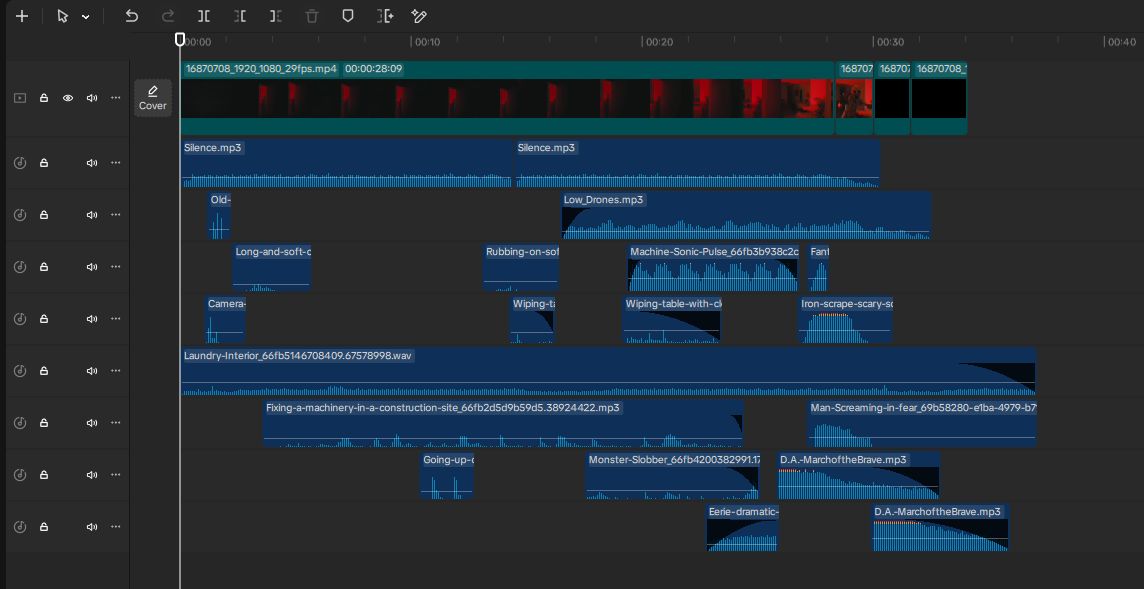
Multiple audio layers of music and sound effects create a realistic environment and bring the visuals to life.
Three Common Horror Sound Design Mistakes
Horror offers plenty of opportunities for creative sound design, but adding more audio does not automatically create more tension. In many cases, restraint produces a much stronger result.
#1 Using Too Much Music
Continuous horror music can quickly lose its effect. If every scene contains ominous drones, dissonant strings, and constant tension, the audience has very little acoustic contrast left when something genuinely important happens.
Tension is most effectively created through a dynamic approach to sound design. Long, sustained tones and subtle dissonances at low volume build anticipation by making the audience wait for something to happen or change sonically.
Allow sections to rely primarily on ambience, Foley, and dialogue. Music can then enter when it serves a specific purpose rather than simply reminding the audience that they are watching a horror movie.
#2 Making Every Sound Too Obvious
Not every frightening sound needs to be a scream, riser, impact, or supernatural noise. Ordinary sounds can often be more effective because they fit naturally into the environment.
A chair moving in another room, a radiator switching on, a phone vibrating upstairs, or an animal suddenly becoming quiet can all create tension in the right context. These sounds work because the audience understands what would normally produce them and notices when something feels slightly unusual.
Establishing a believable acoustic environment first makes these details much more effective. The contrast between normal and abnormal can then become part of the sound design itself.
#3 Ignoring the Environment
Most people subconsciously become skeptical of larger-than-life horror sound effects when the scene itself does not feel authentic. Even the scariest sounds can lose their impact if the environment and situation are difficult to believe.
Every environment offers different opportunities for creating suspense.
An abandoned factory provides machinery, metal, pipes, chains, large reverberant spaces, and industrial noises. A wooden house offers floorboards, walls, plumbing, doors, wind, and structural creaks, while a forest provides vegetation, animals, weather, and distant natural sounds.
Using these existing characteristics will make the soundscape feel connected to the visuals. Often, slightly manipulating a believable environmental sound is more convincing than adding an effect that obviously exists only to frighten the audience.
Why Is Sound Design in Horror Movies Important?
Horror and fear depend heavily on anticipation, and sound is particularly effective at creating it. Unlike visual information, audio can communicate events that are distant, hidden, or completely outside the frame.
Sound also has the ability to change how the audience interprets an image. A person walking through a hallway may appear completely safe with neutral audio, but the addition of a low drone, distant footsteps, or unstable musical textures can transform the same footage into a threatening scene.
Research into horror films reflects how important this relationship is. A comprehensive review published in Frontiers in Psychology discusses sound as one of the genre's most significant elements and examines techniques ranging from dissonant music to jump scares and the startle reflex. Some film scholars have even described horror as a particularly sound-driven form of cinema.
Effective horror sound design controls information, guides attention, shapes the environment, and determines what the audience expects to happen next. In many scenes, what the audience hears before the threat appears is what makes the eventual reveal frightening in the first place.
Keep in mind that silence is one of the most powerful tools in effective horror sound design.
FAQ
1. What makes a sound scary?
Scary sounds often use dissonance, distortion, silence, low drones, or sudden changes in volume. These characteristics can make a sound feel unstable, harsh, or unpredictable. However, context is just as important as the sound itself. An ordinary sound can become frightening when it appears in an unexpected situation.
2. Where to download horror sound effects?
You can download horror sound effects from dedicated sound libraries such as HookSounds. Common effects include screams, breathing, footsteps, impacts, creepy ambience, risers, and scratching sounds. Look for effects that match the environment and mood of your scene.
3. What are Foley sounds?
Foley sounds are everyday noises recreated during post-production by Foley Artists to match actions on screen. Typical examples include footsteps, clothing movement, doors, and objects being handled. Foley gives filmmakers greater control over how these sounds fit a scene. In horror, they can also be exaggerated or processed to increase tension.
4. What sounds are used in horror movies?
Horror movies commonly use screams, footsteps, breathing, whispers, drones, impacts, creaking doors, and unsettling ambience. Low-frequency rumbles and dissonant musical textures are also frequently used. Many of these sounds are processed with distortion, reverb, pitch shifting, or time stretching to create interesting, creative effects. Combining several subtle layers usually creates a more convincing result than relying on one dramatic effect.
5. How does sound create suspense?
Sound creates suspense by controlling what the audience hears and what information is withheld. Distant footsteps, rising music, or an unexplained noise can suggest that something is nearby without revealing it. Silence can also increase anticipation by making the audience wait for the next sound. Alternating between quiet and intense moments increases tension.
6. What is a jump scare?
A jump scare is a sudden, unexpected moment designed to startle the audience, usually by combining a visual reveal with a sharp increase in sound or volume. It works by creating a strong contrast between a quiet or suspenseful buildup and the sudden event.